
 13/11/2026
The Paradigm Shift: From Passive Prompting to Goal-Directed Autonomous Execution
Over the past two years, conversational AI tools like ChatGPT, Claude, and Gemini introduced billions of users to the magic of generative text. However, in enterprise environments, standard chatbots suffer from a critical limitation:they are purely reactive and passive. You ask a question, they write an answer, and their job is done.
Real-world business operations do not run on answers; they run onactions. If a customer cancels an enterprise contract, someone must calculate prorated billing, update the CRM status, notify account managers on Slack, revoke cloud credentials, and trigger a retention survey. A passive chatbot cannot perform these sequential actions independently.
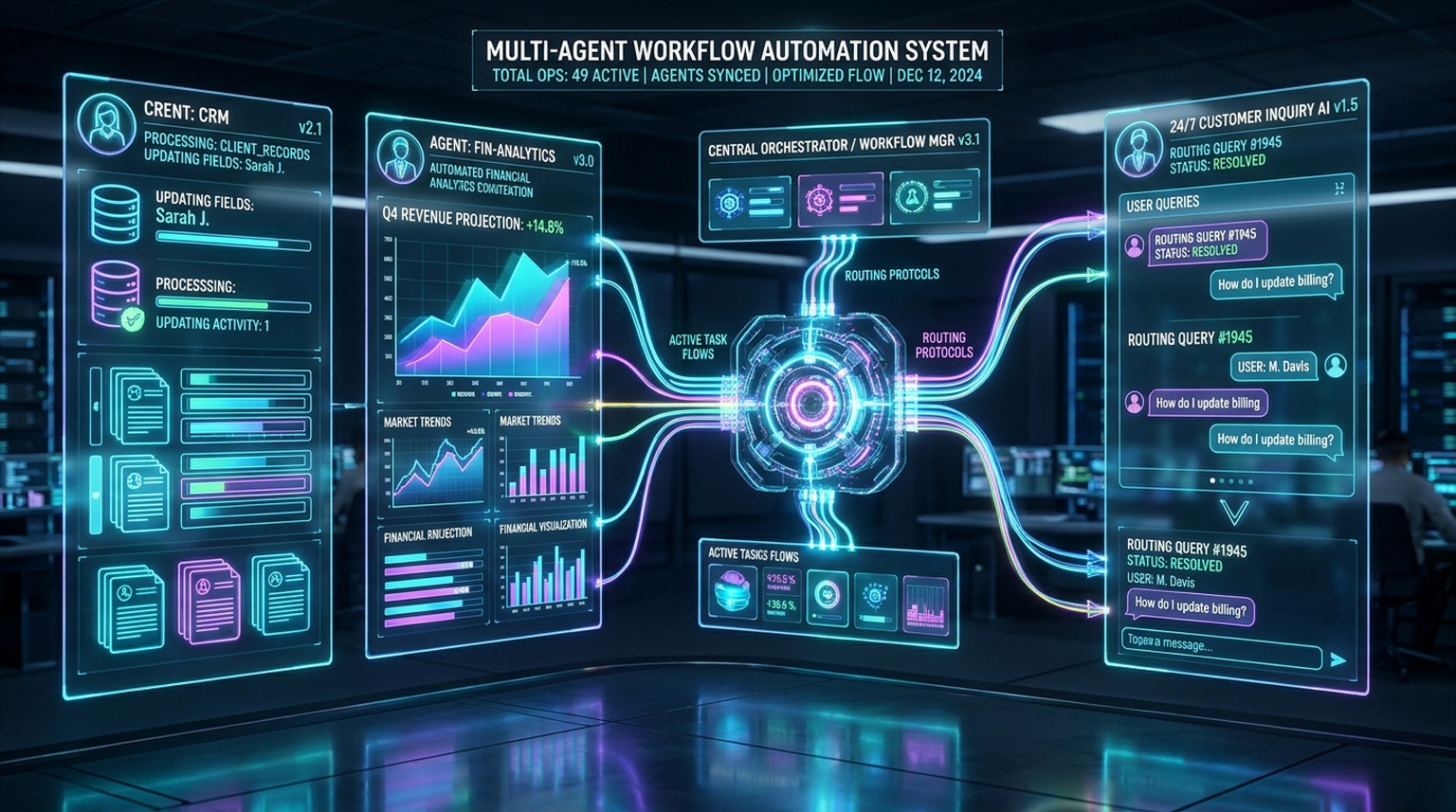
This is where Autonomous AI Agents take center stage in 2026. Equipped with reasoning loops, long-term memory, dynamic planning, and tool-calling capabilities (APIs, databases, web scraping, email), AI agents are given high-level business goals and autonomously determine the step-by-step workflow required to execute them from start to finish.
 by Skylink Infosolutions™
Understanding the Evolution of Automation
Reactive Text Responders
Generates text responses based strictly on input prompts. Unable to interact with external databases, cannot verify outcomes, and possesses zero autonomy to trigger downstream API integrations or multi-step decisions.
Goal-Oriented Action Engines
Given an objective ("Audit vendor invoices against contracts and flag discrepancies"), the agent independently reads PDF files, queries SQL databases, calculates variances, drafts email notifications, and updates ERP systems without continuous human prompting.
Automation Maturity Comparison
| Capability Dimension | Rule-Based RPA (UiPath / Zapier) | Autonomous AI Agents (2026) |
|---|---|---|
| Workflow Flexibility | Extremely rigid: Breaks if UI changes or unexpected input occurs | Adaptive: Uses LLM reasoning to overcome edge cases and format anomalies |
| Handling Unstructured Data | Fails on messy emails, handwritten PDFs, or ambiguous messages | Excels: Seamlessly extracts structured context from any format or language |
| Multi-Step Problem Solving | Follows linear IF-THEN logic programmed in advance | Performs iterative planning, sub-goal generation, and self-correction loops |
| External Tool Integration | Limited to pre-configured API connectors | Dynamic Function Calling: Discovers and calls REST APIs, SQL, and CLI tools on demand |
| Team Collaboration | Single isolated script execution | Multi-Agent Swarms: Specialized agents (Researcher, Writer, Auditor) collaborate together |
Top Real-World Enterprise Use Cases in 2026
💼 1. Auto-Pilot CRM & Inbound Lead Management
AI agents ingest inbound client inquiries across web forms, WhatsApp, and email. The agent enriches the company profile via LinkedIn, checks calendar availability, qualifies budget fit, and schedules introductory discovery meetings—instantly updating Salesforce or custom agency CRMs.
📑 2. Financial Invoice & Contract Auditing
Finance agents continuously scan inbound vendor invoices against active MSA agreements and purchase orders, identifying billing discrepancies, duplicate line items, and missing GST/tax details before routing for human approval.
⚙️ 3. DevOps & IT Support Incident Remediation
When server alarms fire, a site reliability agent reads server log streams, diagnoses memory leaks or failing API endpoints, spins up backup cloud instances, and generates a root-cause summary ticket on Jira automatically.
🔍 4. Competitive Intelligence & Dynamic Pricing
Agents monitor competitor catalog pricing, stock changes, and social sentiment across dozens of e-commerce platforms, autonomously suggesting optimal dynamic price points to maximize profit margins.
The Modern AI Agent Technology Stack
🧠 Agent Orchestration Frameworks
Modern teams build multi-agent architectures using LangGraph, CrewAI, and Microsoft AutoGen, enabling stateful cyclic graphs where agents cross-verify each other's outputs.
💾 Episodic & Semantic Memory
Vector databases (Pinecone, Qdrant, pgvector) provide long-term semantic memory, allowing agents to remember historical interactions, past client preferences, and corporate policies across sessions.
Final Thoughts
Autonomous AI Agents represent the biggest leap in enterprise productivity since the inception of cloud computing. By shifting routine cognitive workflows from human teams to autonomous digital workforces, companies can operate 24/7 with zero operational friction, unparalleled consistency, and exponential scalability.
At Skylink Infosolutions, our specialized AI engineering team architects secure, private multi-agent platforms and custom workflow automations integrated directly into your existing CRM, ERP, and database systems. Schedule a consultation today to explore how autonomous agents can transform your enterprise.