 23/10/2026
The Battle for Cross-Platform Supremacy in 2026
In modern software development, building standalone native apps for both iOS (Swift/SwiftUI) and Android (Kotlin/Jetpack Compose) from scratch often doubles engineering costs, complicates maintenance, and delays go-to-market timelines. As a result, cross-platform frameworks have become the undisputed standard for startups, SMBs, and Fortune 500 enterprises alike.
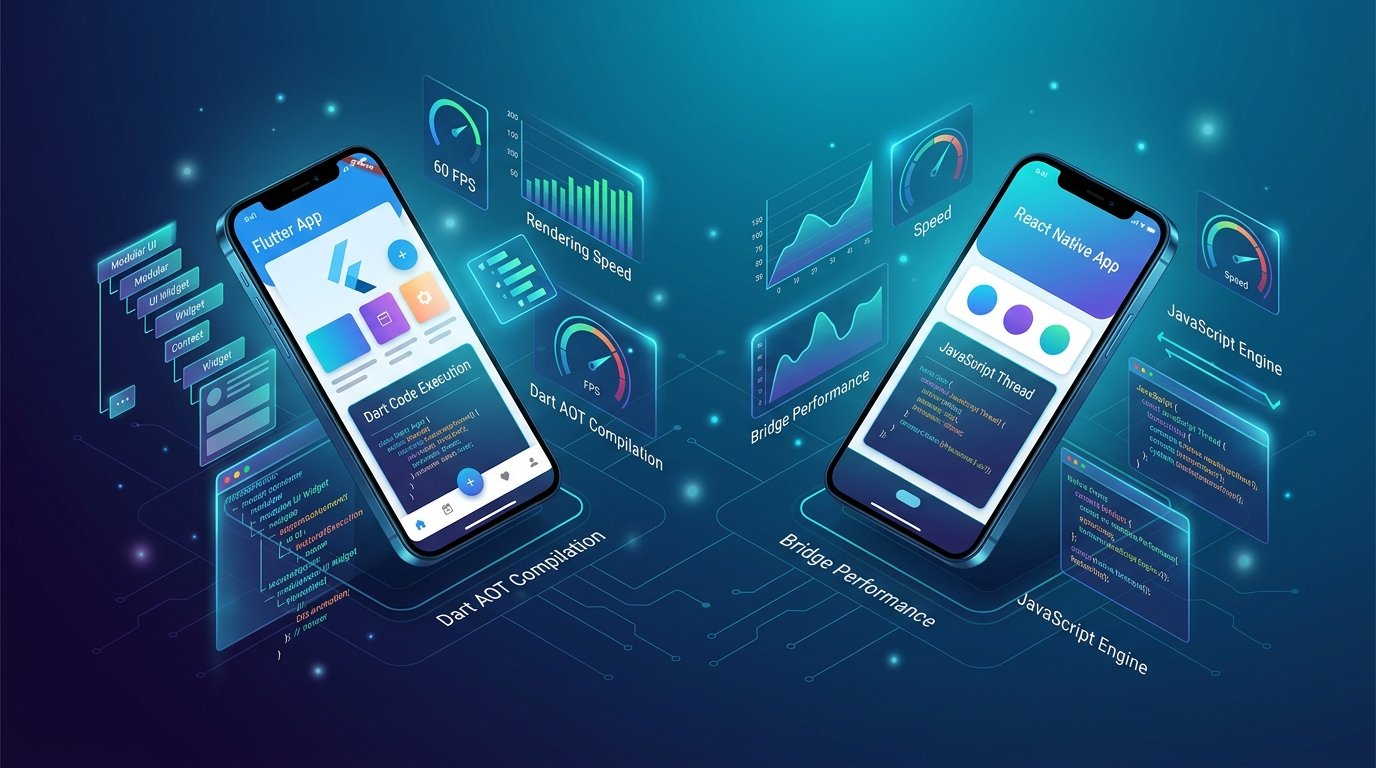
Two powerhouses dominate this space: Google's Flutter and Meta's React Native. Both platforms have evolved dramatically by 2026. Flutter has cemented its position with the groundbreaking Impeller rendering engine and stellar desktop/web compilation, while React Native has completed its transition to the New Architecture (Fabric renderer and TurboModules), bringing near-instant native bridging and blazing speeds.
So, which framework should your business choose for your next mobile product? Let’s dissect their architecture, performance, developer talent pool, maintenance overhead, and long-term business ROI.
 by Skylink Infosolutions™
Core Architectural Differences: How They Work
Own Rendering Engine (Impeller)
Flutter doesn't rely on OEM native widgets. Instead, it draws every single pixel on screen directly using its hardware-accelerated Impeller engine. This guarantees 100% pixel-perfect UI consistency across all devices, zero shader compilation jank, and high-performance 120 FPS animations.
Native Component Bridge (Fabric)
React Native compiles down to authentic native iOS and Android UI elements. With the New Architecture and Hermes JavaScript engine, JS threads communicate directly with C++ native components via JSI (JavaScript Interface), eliminating legacy JSON bridge bottlenecks.
Direct Feature-by-Feature Comparison
| Criteria | Google Flutter | Meta React Native | Skylink Verdict |
|---|---|---|---|
| Programming Language | Dart (Object-Oriented, strongly typed) | JavaScript / TypeScript | React Native wins for team onboarding; Flutter wins for type safety and compilation. |
| UI Consistency | 100% identical look and feel across iOS and Android | Adopts platform-native styles automatically | Flutter for brand-centric custom designs; React Native for OS-native feel. |
| Runtime Performance | Near-C++ native speed with Impeller; smooth 120Hz | Near-native with Hermes engine and TurboModules | Flutter leads in complex animations, games, and heavy UI graphics. |
| Code Sharing (Web & Desktop) | True multi-platform (Mobile, Web, Windows, macOS, Linux) | Primarily mobile (Web via React Native for Web) | Flutter excels when targeting desktop, embedded systems, or unified codebases. |
| Ecosystem & Libraries | Pub.dev (curated, official Google plugins) | NPM (massive library ecosystem) | React Native offers access to the world's largest package ecosystem. |
| Time to Market (MVP) | Rapid with pre-built Material & Cupertino widgets | Rapid if your team already knows React/Web | Tie: Both enable launching an MVP in 4–8 weeks. |
How We Build Scalable Mobile Apps at Skylink
📱 Phase 1: UX/UI Prototyping & Architecture Selection
We evaluate your business goals, target audience, hardware integrations (Bluetooth, camera, GPS, biometrics), and offline-first requirements to pick the ideal framework.
⚡ Phase 2: Core Development & State Management
Using clean architecture (Bloc/Riverpod for Flutter, Zustand/Redux Toolkit for React Native), we develop modular, test-driven application code with seamless API consumption.
🧪 Phase 3: Automated QA & Device Lab Testing
We run automated integration tests across 30+ physical Android and iOS devices, validating screen responsiveness, battery consumption, network latency, and memory leaks.
🚀 Phase 4: App Store & Play Store CI/CD Deployment
Automated fastlane pipelines build, sign, and release production binaries directly to Google Play Store and Apple App Store with zero downtime and automated rollbacks.
Which One Should You Choose for Your Business?
Choose Flutter If:
- You need heavily customized, custom-branded UI elements and complex micro-animations.
- You want to compile to Mobile, Desktop (Windows/macOS), and Web from a single codebase.
- Your application requires high compute processing or real-time graph rendering.
- You value single-source UI consistency over OS-native widget behaviors.
Choose React Native If:
- Your existing engineering team is proficient in React and modern JavaScript/TypeScript.
- You want to share business logic, types, and hooks between your React web app and mobile app.
- Your app relies heavily on OS-native APIs, system widgets, and third-party native SDKs.
- You want instant Over-The-Air (OTA) updates using tools like Expo and CodePush.
Final Verdict
Both Flutter and React Native are mature, battle-tested, enterprise-grade frameworks. In 2026, you cannot go wrong with either choice. The decision primarily hinges on your current team skill set, design philosophy, and platform reach goals.
At Skylink Infosolutions, our mobile development team specializes in architecting high-converting, resilient apps on both Flutter and React Native. Whether you need a lightning-fast MVP for a startup pitch or an enterprise-grade mobile suite, we help you engineer it right from day one.