 08/04/2026
Understanding AI Agents: The Future of Intelligent Automation
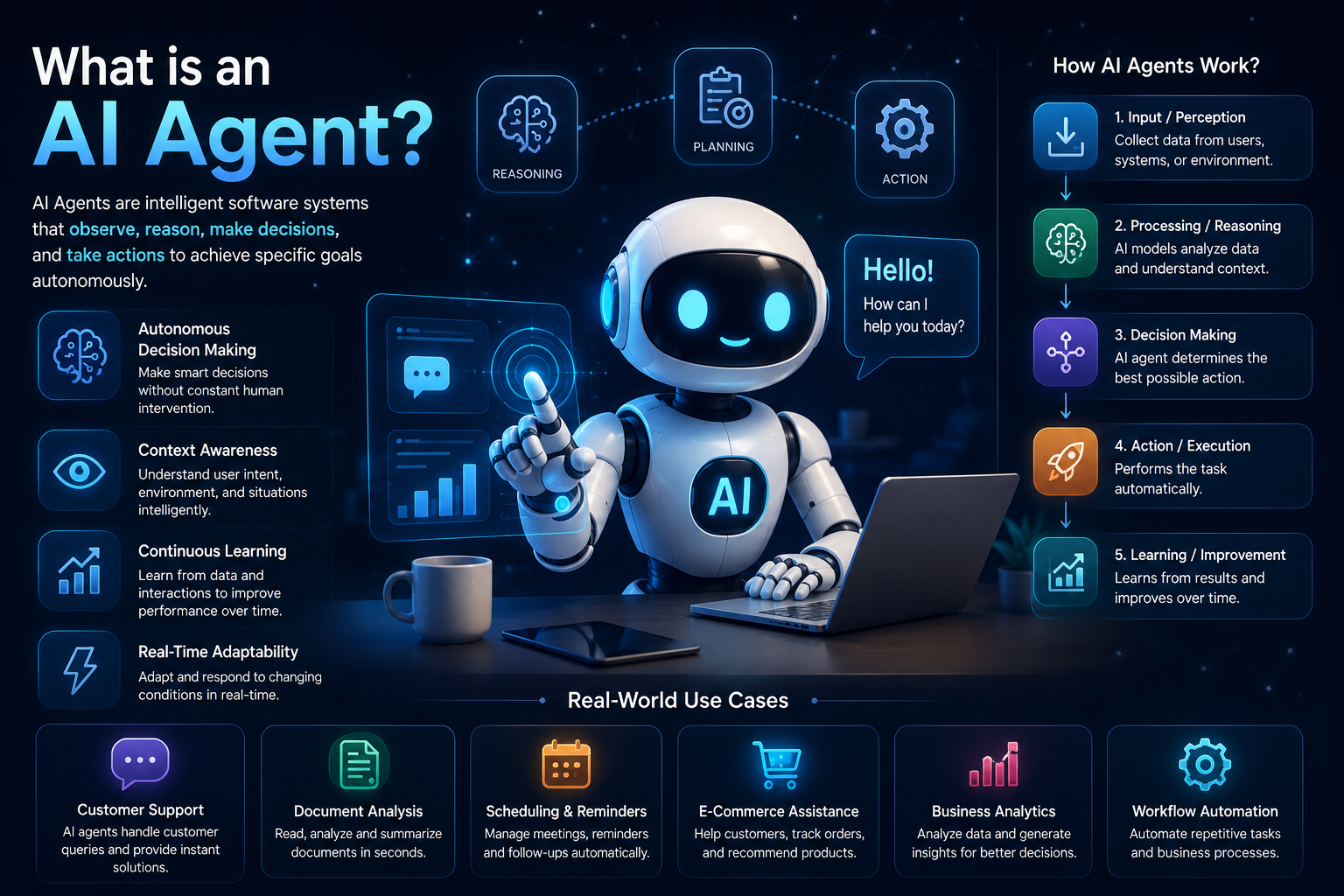
Artificial Intelligence is evolving rapidly, and one of the most exciting innovations in this space is the rise of AI Agents. These intelligent systems are designed to observe, reason, make decisions, and perform tasks autonomously.
Unlike traditional automation tools that simply follow predefined rules, AI agents can adapt to changing situations, understand context, and improve their performance over time. From virtual assistants and customer support bots to intelligent business automation systems, AI agents are transforming how organizations operate.
 by Skylink Infosolutions™
What Exactly is an AI Agent?
An AI Agent is a software entity capable of perceiving its environment, processing information, making decisions, and taking actions to achieve specific goals.
In simple words, AI agents behave like intelligent digital assistants that can think, analyze, and respond dynamically.
- Observe user inputs, systems, or environments.
- Analyze information intelligently using AI models.
- Decide the best possible action automatically.
- Act independently to complete tasks or solve problems.
How Do AI Agents Work?
AI agents operate through a cycle of observation, reasoning, decision-making, and execution. They continuously process information and improve responses using artificial intelligence techniques.
👀 Input Collection
AI agents receive data from users, systems, APIs, sensors, or applications.
🧠 Data Processing
Machine learning and AI models analyze the information to understand context and intent.
⚡ Decision Making
The AI agent selects the most appropriate action based on goals and available data.
🚀 Task Execution
The agent performs actions automatically such as replying, generating reports, or automating workflows.
Core Components of AI Agents
📡 Perception System
Helps the AI agent gather information from environments and systems.
🧠 Reasoning Engine
Processes data, understands context, and generates intelligent decisions.
⚙️ Action Module
Executes actions like sending messages, updating systems, or automating tasks.
Types of AI Agents
| Type | Description |
|---|---|
| Simple Reflex Agents | React based on predefined conditions. |
| Learning Agents | Improve performance using data and experiences. |
| Goal-Based Agents | Make decisions to achieve specific objectives. |
| Autonomous Agents | Operate independently with minimal human intervention. |
Real-World Business Applications
💬 AI Customer Support
AI agents provide instant responses, handle queries, and improve customer experiences.
📊 Intelligent Analytics
AI agents analyze business data and generate predictive insights automatically.
📂 Workflow Automation
AI agents automate repetitive office processes intelligently.
🏥 Healthcare Assistance
AI agents assist doctors with scheduling, diagnostics, and patient support systems.
The Future of AI Agents
AI agents are becoming more powerful with advancements in large language models, machine learning, and intelligent automation platforms.
Future AI agents will manage complex business operations, collaborate with humans, and autonomously handle entire workflows across industries such as finance, healthcare, compliance, customer service, and enterprise automation.
Final Thoughts
AI Agents are transforming the future of intelligent systems. They go beyond simple automation by understanding context, making decisions, and acting autonomously.
As businesses continue adopting AI technologies, AI agents will become a critical part of digital transformation, helping organizations operate smarter, faster, and more efficiently.