 31/08/2026
Choosing Software That Fits the Way Your Business Works
Every business needs software to manage customers, operations, communication, reporting, and day-to-day workflows. The challenge is deciding whether to adopt an existing off-the-shelf product or invest in software designed specifically around the organization's processes.
Off-the-shelf solutions can provide a quick starting point with ready-made features and established workflows. Custom software takes a different approach: instead of asking the business to adapt to the product, the product is designed around the business's requirements.
The right choice depends on factors such as workflow complexity, integration needs, scalability, security requirements, budget, and how much control the organization needs over its technology.
 by Skylink Infosolutions™
Understanding the Two Approaches
📦 Off-the-Shelf Software
Ready-made software built for a broad market. It can often be deployed quickly and may include many standard business features from day one.
🛠️ Custom Software
A solution designed around specific business processes, user roles, data relationships, integrations, and operational requirements.
🎯 The Right Fit
The best choice depends on how closely existing software matches the organization's actual workflows and future plans.
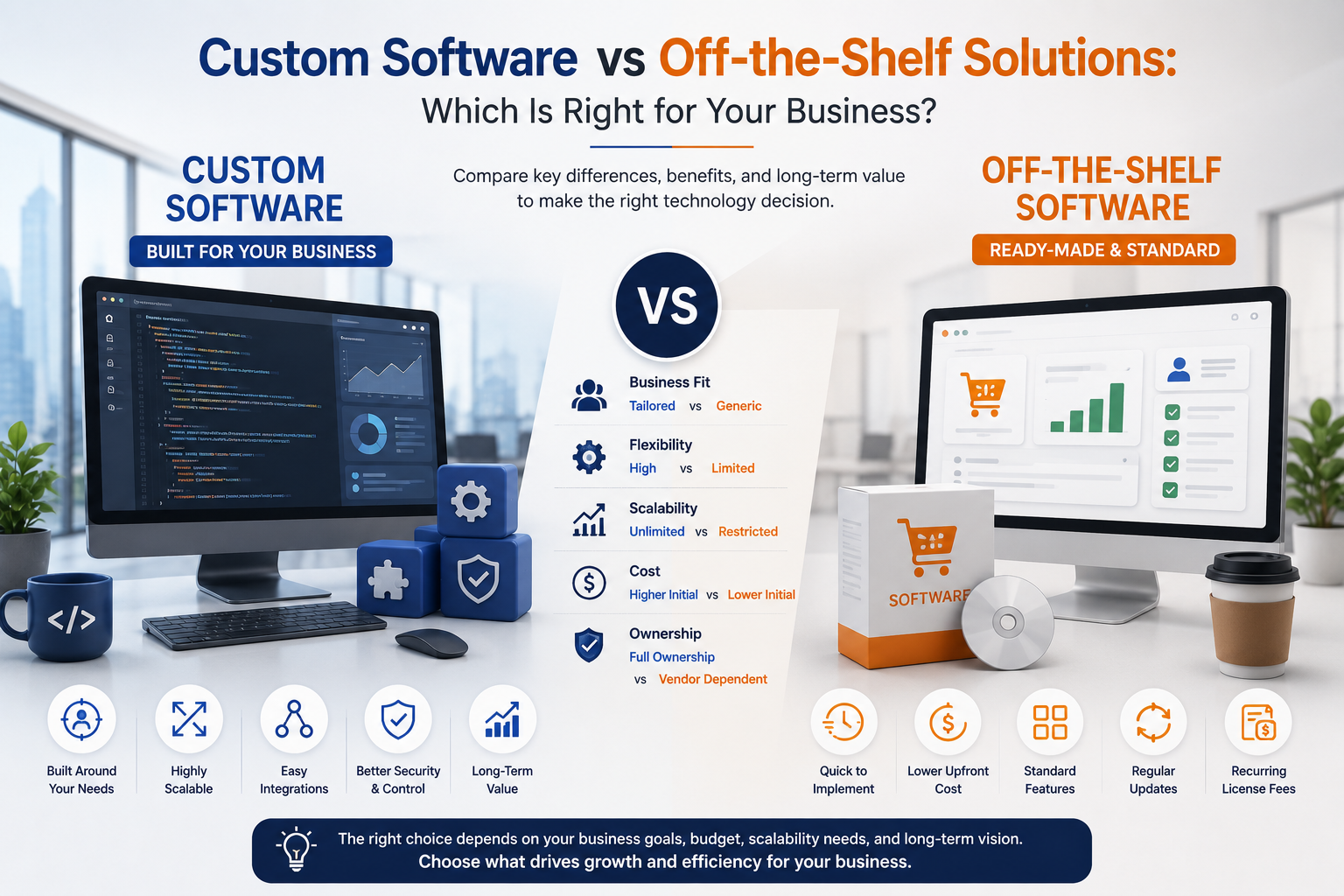
Custom Software vs Off-the-Shelf Solutions
| Custom Software | Off-the-Shelf Software |
|---|---|
| Built around specific business requirements | Built for a broad range of businesses |
| High flexibility for workflows and features | Features are generally predefined |
| Can be designed for required integrations | Integration options depend on the product |
| Greater control over product roadmap | Roadmap is controlled by the software provider |
| Can scale with evolving business requirements | Scaling depends on available plans and capabilities |
| Usually requires greater initial development effort | Often faster to deploy initially |
How to Decide Which Approach Fits
🔍 Step 1: Map Your Current Workflow
Identify the processes your teams actually follow, including approvals, customer journeys, reporting, data entry, and operational handoffs.
🧩 Step 2: Identify the Gaps
Compare those requirements with the features available in existing products. Pay attention to workarounds, duplicate data entry, and missing integrations.
📈 Step 3: Consider Future Growth
Evaluate whether the solution will continue to support additional users, departments, locations, products, integrations, and changing business processes.
⚖️ Step 4: Compare Total Value
Look beyond the initial price and consider implementation, subscriptions, customization, integration, training, maintenance, and the operational value delivered.
When Custom Software Can Be a Strong Choice
🔗 Complex Integrations
Businesses that need software to connect with CRMs, ERPs, APIs, external lead platforms, payment systems, or other internal tools.
⚙️ Specialized Workflows
Organizations with processes that are too specific or complex to manage efficiently through standard software.
📊 Data & Reporting Needs
Businesses requiring dashboards, reports, relationships, and operational visibility tailored to their own data structure.
🚀 Long-Term Scalability
Organizations planning to expand and wanting their software architecture and product roadmap to evolve with the business.
Questions to Ask Before Choosing
- ❓Does the software match our current business workflow without excessive workarounds?
- 🔐What level of control do we need over data, access, security, and system behavior?
- 🔗Which existing systems and third-party platforms must the software integrate with?
- 📈Will our requirements change significantly as the business grows?
- 💰What is the total cost over the expected lifetime of the solution, not just the initial purchase?
Cost Is More Than the Initial Price
An off-the-shelf product may have a lower initial barrier to adoption, but businesses should also consider recurring subscriptions, paid add-ons, customization limitations, integration costs, migration, training, and process changes.
Custom software generally requires more planning and development at the beginning. However, when a business has specialized workflows or significant integration requirements, a tailored system can provide value by reducing manual work and avoiding repeated workarounds.
Security, Control & Ownership
Security requirements vary by business and should be evaluated based on the type of data being handled, user roles, access controls, integrations, hosting model, and operational processes.
Custom development can provide greater control over how roles, permissions, workflows, and integrations are designed. Off-the-shelf products can also provide strong security capabilities, but the available controls and architecture depend on the specific product and provider.
Final Thoughts
There is no universal winner between custom software and off-the-shelf solutions. A ready-made product can be the right choice when standard functionality meets the business needs and speed of deployment is important.
Custom software becomes particularly valuable when workflows are specialized, integrations are critical, or the organization needs greater flexibility and control. The strongest decision comes from evaluating the actual business process first and then choosing the technology approach that supports it.